
Hello!

Introducing “Time to FPI” – A New Strategic KPI at Pratia
As part of our strategic direction – “We bring confidence of clinical trial project success” – we continuously challenge ourselves to improve project delivery performance and meet the expectations of our Clients, including pharmaceutical companies and CROs.
One of the key performance indicators increasingly monitored by our Clients is the time between site activation and enrollment of the first Patient. From a Client perspective, a site that is activated but not recruiting does not yet contribute to study success. Moreover rating low in this parameter may decrease our chances competing with other sites for new projects. Therefore, we are introducing a new strategic Pratia metric:
Time to First Patient In (Time to FPI)
This metric measures the number of days between site activation and enrollment of the first Patient. While oncology studies often involve factors outside our direct control, such as waiting for dedicated treatment slots, our ambition—particularly in non-oncology studies—is to have the first Patient enrolled as soon as possible after activation, ideally within 24 hours.
Achieving this goal requires thorough recruitment preparation before every study starts. Responsibility for this preparation lies with the Site Manager, who coordinates recruitment planning using all available Patient sources, including:
To support site readiness and ensure visibility of recruitment preparedness, Prescreening Lists have been established as a standard process for every study at every site. Compliance with this process remains the responsibility of the Site Manager.
As previously communicated by the Patient Engagement Team (Aleksandra Salawa and Wojciech Bykowski), Prescreening Lists have recently been enhanced through:
to improve transparency, tracking, and day-to-day usability.
In 2025, the average time from SIV to First Patient In across our sites was 55 days. To improve visibility and better understand performance drivers, we will begin tracking this metric separately for oncology and non-oncology studies. Additionally, upcoming enhancements in Hyggio will introduce a dedicated Site Activation Date field. This will allow us to measure performance more accurately and eliminate bias resulting from delays between the Site Initiation Visit (SIV) and actual site activation.
Our ambition is clear: to become the industry leader in rapidly initiating recruitment immediately after site activation while consistently delivering on our recruitment commitments. This objective directly complements our existing strategic performance indicator, the Delivery Index, which measures our ability to achieve contracted recruitment targets.
Success in this area requires commitment from all of us—Site Teams, Site Managers, Patient Engagement, Operations, and support functions. Every day gained between activation and the first Patient enrolled accelerates study timelines, strengthens Client confidence, and reinforces Pratia's position as a trusted partner in clinical trial delivery.
Thank you for your continued commitment and focus on operational excellence.
Łukasz Bęczkowski,
Chief Executive Officer, Pratia

Investigator referrals,
Referring physicians,
Site Patients database,
Recruitment campaigns supported by the Patient Engagement team whenever needed.

Revised Patient statuses,
Additional comment fields,
Culture Champions — Final Days to Nominate
We encourage you to recognize someone who brings our values to life before the nomination window for this month’s Culture Champions closes at the end of May.
This month, we’re focusing on Collaborate to Win and celebrating employees who support others, share knowledge, work across teams, and contribute to collective success.
Do you wonder what meaningful collaboration looks like across our teams?
Dannelle Palmer, our Chief of Staff, shared this message on the value of working together:
For me, “Collaborating to Win” is an ongoing commitment to show up with a positive, inclusive mindset and to focus on how we can succeed together. It’s about building on each other’s strengths, learning along the way, and making sure our wins are truly shared. The work we do is important, but how we work together matters just as much. I’m grateful to be part of this team and excited about what we can continue to accomplish when we collaborate openly, thoughtfully, and as one.
Don’t miss the opportunity to recognize a collegue before nominations close. Think about the people who make collaboration easier every day. Their impact may seem small in the moment — but it helps shape the culture we build together.
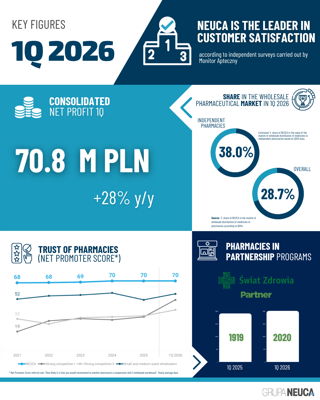
NEUCA: Key Figures for 1Q 2026
As Humeneva Group operates within the broader NEUCA Group structure, we are presenting the NEUCA Group’s financial resultsand key performance figures for 1Q 2026.
Clinical Development Is Getting Harder — And Execution Is Becoming the Advantage
Industry Direction: Complexity Is Winning
Clinical development is no longer being defined by scale alone. Across the market, trial starts have remained relatively flat, yet R&D spend continues to rise steadily. That divergence matters. Sponsors are spending more, but not because the industry is producing materially more trials. They are spending more because trials are becoming harder to design, harder to recruit for, and harder to execute. The result is a widening productivity gap: more capital is required for each successful outcome, while execution risk continues to climb.
Nowhere is this more visible than in oncology. Oncology has become the clear center of gravity in clinical development, representing more than a third of global trial starts and an even greater share of strategic attention and R&D investment. But it is also the therapeutic area where the industry’s structural weaknesses are most exposed. Protocols are more complex. Eligibility criteria are narrower. Biomarker-driven populations are smaller. Competition for the same Patients is intense. Screen failure rates are high, recruitment timelines are volatile, and trial execution often breaks down at the site level.
This is why oncology is not just the largest opportunity in the market. It is also the hardest to execute well. And that distinction is becoming commercially decisive.
At the same time, outsourcing spend is continuing to grow, but its composition is changing. Traditional site spend is maturing more slowly, while CRO and technology spend are increasing faster as sponsors look for more coordinated, outcome-oriented delivery models. The market is moving away from fragmented vendor stacks and toward execution models that can combine access, delivery, and visibility in a more integrated way.
That shift has important strategic implications. In a market defined by complexity, the winners are unlikely to be those with the most capacity alone. They will be the organizations that can reduce uncertainty: improving Patient access, increasing enrolment performance, tightening coordination across stakeholders, and creating greater certainty of execution.
This is precisely why an integrated oncology model is becoming more relevant, not less. Humaneva’s direction reflects that market reality. By combining oncology-focused sites, CRO capabilities, and enabling technology into a single operating model, Humaneva Oncology is aligned to where the industry is moving toward fewer, more complex, higher-value trials where execution quality matters more than scale, and where integrated delivery can create disproportionate value.
References:
•IQVIA Institute for Human Data Science, Global R&D Trends 2026: Advancing Innovation in a Changing Landscape, February 2026 (Citeline Trialtrove data)
•Evaluate Pharma, World Preview Reports
•Nature Reviews Drug Discovery, post-COVID clinical trial activity and productivity trends
•Grand View Research, clinical trials and CRO market analyses•MarketsandMarkets, clinical trial outsourcing market reports
Market Context: Enrollment Pressure and Sponsor Patient Strategies
Global clinical development continues to face significant and structural enrollment pressure, driven by both longer enrollment timelines and the scale of Patients required worldwide. According to the IQVIA Institute, clinical trials initiated in 2025 are expected to enroll approximately 1.2 million Patients globally, including over 300,000 Patients in oncology. While volumes declined modestly versus 2024, they remain above pre-pandemic levels, maintaining persistent demand on research sites and Patient access pathways.
At the same time, enrollment timelines continue to extend. Median enrollment duration increased from 14.9 months in 2024 to 16.3 months in 2025, confirming enrollment as the longest and most productivity constraining phase in clinical development.
Enrollment Pressure by Therapeutic Area and Study Phase
Enrollment challenges remain most pronounced in areas of high complexity:
•Oncology represents the most significant challenge, with median enrollment durations of approximately 29 months in 2025. Although oncology enrollment improved in 2024–2025 after peaking around 33 months in 2023, the high proportion of oncology trials completing enrollment remains the primary driver of overall industry pressure.
•Neurology and immunology follow, reflecting complex Patient pathways and eligibility requirements.
Enrollment pressure is also increasingly evident in earlier phase trials. Phase I and Phase II studies experienced further lengthening of enrollment timelines, reflecting increasing protocol complexity, narrower eligibility criteria, and intensified competition for Patients earlier in development.
Sponsor Response: Patient Focused Strategies
In response, sponsors are intensifying their focus on Patient centered strategies. Across organizations, the leading strategic priorities remain:
•Increasing overall enrollment
•Improving Patient retention
•Removing barriers to Patient participation
Sponsors are increasingly incorporating Patient experience into study design, expanding virtual and hybrid trial models, partnering with Patient advocacy organizations, and strengthening site level execution. Alignment across sponsor sizes is growing, reflecting broad consensus that enrollment execution is now the defining determinant of trial success.
How We at Pratia Continue to Rise to These Challenges
As Pratia, we are in a privileged position as a site network to directly influence one of the most critical challenges in clinical development today: Patient enrollment timelines. Operating a network of owned and embedded research sites creates both responsibility and opportunity —giving us a unique platform to continuously improve, learn, and excel in how we deliver studies for our sponsors Patients.
Enrollment pressure is not static, and neither is our ambition. While it remains the single largest constraint in clinical development, it is also an area where our collective focus, operational discipline, and commitment to improvement can make a meaningful difference. By consistently strengthening site level execution, we aim to increase sponsor confidence in reliable delivery, which is central to our strategic direction.
The most pronounced industry challenge continues to be oncology enrollment timelines, and this reality is fully aligned with our strategic focus on growing oncology capabilities. Our investment in oncology reflects both market demand and Patient need, acknowledging that oncology studies combine high complexity, intense competition for Patients, and structurally longer enrollment timelines.
P1 Pratia Oncology, our early phase oncology platform, exemplifies this journey. It brings together two of the most demanding dimensions in clinical development—oncology and early phase execution—and continuously strenghthens our ability to identify, engage, and support Patients in highly complex studies.
At the same time, growing sponsor investment in Patient focused strategies creates a meaningful opportunity to further evolve our model. Our in house Patient Engagement function enables us to translate Patient-centric intent into consistent site-level practice—improving recruitment, retention, and barrier reduction in ways that directly support execution quality.
Ultimately, as Pratia, our aspiration is not simply to respond to enrollment challenges, but to get better at addressing them every day. By doing so, we strengthen our role as a trusted partner, build our industry reputation, and—most importantly—help ensure that Patients gain timely and meaningful access to innovative therapies through the clinical trials we deliver.
Sources:
•IQVIA Institute for Human Data Science, Global R&D Trends 2026: Advancing Innovation in a Changing Landscape, February 2026 (Citeline Trialtrove data)
•PPD, Thermo Fisher Scientific, The Pulse 2026: Global R&D Insights in Pharmaceuticals, 2026
Market Context: Strengthening Oncology Trial Execution Where Complexity Breaks the System
Oncology clinical trials are increasingly defined not by scientific ambition alone, but by the ability to execute highly complex studies reliably, predictably, and at speed. Protocols are more demanding, patient populations are narrower, and operational risk concentrates early, especially in oncology and cell & gene therapy programs. Kapadi exists to solve for this reality, bringing operational precision, site ownership, and integrated technology to the most challenging stages of oncology drug development.
Deep Oncology Specialization as an Operational Advantage
Kapadi is purpose built as a global oncology CRO, with concentrated expertise across solid tumors, hematologic malignancies, immuno oncology, and cell & gene therapy. Rather than distributing capability broadly across indications, Kapadi focuses on the therapeutic areas where protocol complexity, safety oversight, and enrollment risk are highest. This depth allows for better protocol design support, faster issue identification, and fewer execution handoffs, particularly in early phase and first in human oncology studies.
Site Centric Operations That Reduce Execution Variability
Kapadi’s clinical operations model is intentionally site centric and flat, designed to eliminate fragmentation. Each site is owned end to end by a dedicated CRA, ensuring continuity of knowledge from site activation through closeout. Project managers serve as single operational leaders, reducing layers of communication and minimizing misinterpretation, which is an especially critical advantage in oncology trials where deviations and delays compound quickly.
This operating model improves predictability at the point where oncology trials most often fail: site level execution under pressure.
Precision Patient Access and Enrollment Models
Kapadi directly addresses one of oncology’s most persistent constraints: patient access and enrollment predictability. Through vetted site networks across North America and Europe, including Pratia as well as oncology specialized networks trained for complex trials, Kapadi expands access to relevant patient populations while maintaining execution quality.
A core differentiator is Kapadi’s Just In Time (JIT) site activation model, which aligns site activation with confirmed patient availability. This reduces wasted startup effort, accelerates enrollment, and mitigates financial and operational risk for sponsors, which is particularly valuable in rare, biomarker defined oncology populations.
Kapadi in the Oncology Ecosystem
From a CRO perspective, Kapadi’s role in oncology is clear: reduce uncertainty where it matters most at the intersection of complex protocols, demanding sites, and limited patient populations. By combining deep oncology expertise, site owned delivery, integrated technology, and patient centric access models, Kapadi strengthens execution reliability and accelerates timelines without sacrificing rigor.
In a market where oncology trial complexity continues to rise, Kapadi contributes not simply capacity, but operational confidence, helping sponsors move from scientific intent to clinical reality with greater certainty.
Jonathan Burr
Humaneva CCO
Łukasz Beczkowski
Pratia CEO
Krystyna Kowalczyk
Kapadi CEO
Remember to follow us on linkedIn!
Hi! I’m Justyna
I'm here to keep you informed with key updates about our organization and the world of clinical trials. Feel free to reach out to me at: justyna.koltonska@humaneva.com
ABOUT ME
justyna.koltonska@neuca.pl